TCU Coach Sonny Dykes Gives Injury Update on Star RB Kendre Miller
Real Georgia Fans Don’t Miss the Dawg Post Newsletter - Sign up now!
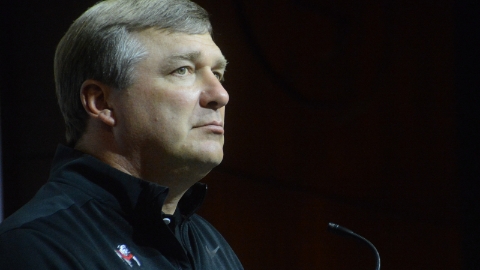
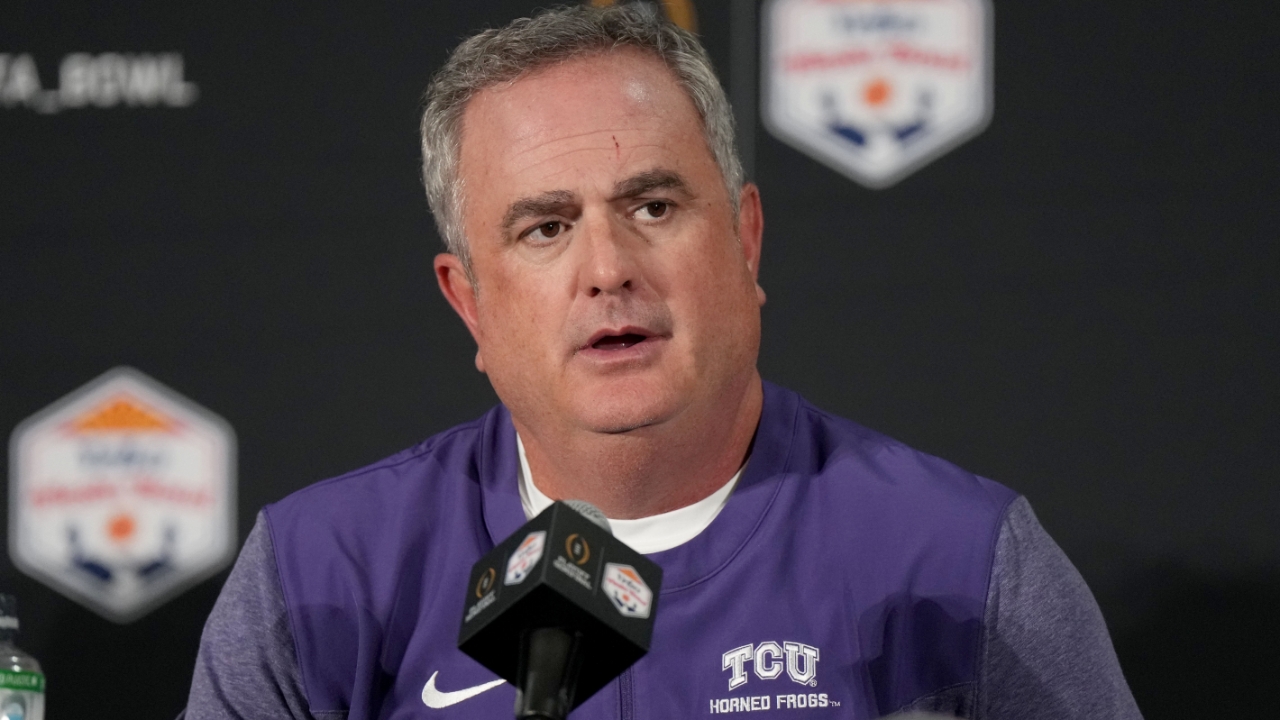
Los Angeles, CA - TCU head coach Sonny Dykes spoke with reporters on Sunday as they prepare to take on Kirby Smart and the Georgia Bulldogs for the 2023 CFP National Championship.
Q. Coach Dykes, the 12 personnel that Georgia stays in offensively or has offensively, what kind of challenges does that present?
COACH DYKES: I think the second part of the thing, asking about 12 personnel. You know what's interesting about 12 personnel, a lot of people run 12 personnel. What you do is -- this is something that, it's something that we've done in the past. I was a Mike Leach disciple, kind of 10 personnel guy. That was something that Mike did different was, to Cal's offense, it was a lot of 20s and 21 personnel groupings. And made it basically a 10 personnel offense and started to play with tempo and all the things that kind of made Mike's version of the air raid different and unique.
As a young coach, I took a coordinator job at the University of Arizona. And had a tight end named Rob Gronkowski that was a pretty good player.So it was like, okay, I've never played with a tight end. I don't even know what a tight end looks like. And this is what he looks like.
So let's figure out a way to get this guy the ball. So all of a sudden we're lining up in 11 personnel and some 12. And the thing that's different about it is, you know, you've got to play eight gaps. Your run fits are much more complex, how you're going to get to them is much more difficult.
Now, from a run game perspective you've got to cover all these gaps that you don't necessarily have to cover without the 12 personnel. So it just changes the way you approach the game defensively.
Most people, when they go 12, they're taking two good players off the field and putting two average players on the field. Well, Georgia certainly is the exception to that. Their tight ends are exceptional. And they are -- wide receivers are like Rob; they're wide receivers that are 270 pounds and can block.
The thing that's unique about those two tight ends is they like to block. They're physical-minded guys. They're very skilled receivers, but they play a tough brand of football. And that's what makes Georgia's 12 different than everybody else's. As I said earlier, most guy are taking out a good player and putting in some average, at best, player because they want to change the run fits or make it a little bit more difficult for a defense to prepare for.
These guys are doing it with, you know, arguably two of the best tight ends in college football and some really exceptional athletes.And again the thing that stands out about them is their toughness and their willingness to go in there and mix it up and their effectiveness as blockers.
Q. Addressing injuries going into tomorrow's game, what's the latest update on Kendre Miller, Coach Dykes?
COACH DYKES: Kendre, we'll have a run through today that's our typical Friday run-through, the day before the game, full speed run-through. We'll get a really good sense of what he can and can't do today, and then make a decision going into tomorrow.
So running backs are different, when you talk about a running back and you're talking about a thigh bruise or a sprained shoulder or a contusion some place, those are things that running backs can typically play through. When you start talking about a knee and a sprained knee and the things that go along with that, potentially, then you've got to be very, very careful.
And obviously Kendre is going to want to play. It's a big stage. He's a tough kid. But he's a young man. And our job is to take care of him and make sure that we don't just see Monday night, that we see the big picture as far as taking care of Kendre's health and in doing the right thing for him -- again, not just for Monday, but for his immediate future. So we'll take it all in today, see where he's at, then make a decision.
Q: Coach Dykes, can you speak to the fact of TCU's becoming a national brand. Earlier this week on TNT, Ernie Johnson, a Georgia grad, bet Shaq that Georgia would win by 28. And Shaq, who lives in Texas, said he'd eat a Horned Frogs if it happened here. But here's an NBA show talking about TCU football.
COACH DYKES: I'll say this: You look around college athletics and look at the NCAA basketball tournament, and you see teams that you don't expect to be there, end up in the top eight or Final Four. That's something that's an annual occurrence these days. You know, college football is different. It just is. There's a lot of plays that go into that game. There's a lot of players. Instead of five guys and one or two guys get really hot, you've got to have an entire team doing it and execute at a high level.
So I do think it's more difficult to kind of emerge from the shadows in football than it is maybe in basketball. Our group has had a little bit of a magical ride. And I think the biggest difference is that it's our first year. We were still trying to get to know the guys. We're still trying to get a culture established. I just think at the end of the day that's the most important thing is what is your culture, because it drives the decision a player makes from the time they wake up in the morning to the time they go to bed.
What is their level of commitment? What's their level of responsibility to their teammates? How deeply are they truly invested in the team? And so there's all these things that sometimes take time. To our players' credit, for whatever reason, it didn't take as long this time as it usually does. Our guys were hungry and they were mature. They had a chip on their shoulder. And they bought in quickly.
Now, the challenging thing, as we move forward, past Monday, is where do we go from here? And there's a standard now that -- and a set of expectations that accompany this kind of success. And to me that's the exciting part. It really is. I mean, you really get to find out how good you are. It's one thing to get to the top. It's another thing to be able to stay there.
Q. Obviously the mission is to compete for a national championship. But can you explain how the practice time and this time of year is so important to the development and maturity of your younger players?
COACH DYKES: It's obviously been a big thing for us. Again, we've had lots of practice opportunities. We've had an additional 15 leading into the semifinal game that our players haven't had in the past.
So if you think about it, you know, if you're a senior team and if you're a senior player and you've been in a practice that has consistently been to bowl games, and particularly New Year's Day bowl games, or bowl games that occur later during the bowl game cycle, you look up and you go, okay, it's 15 practices for four years. That's 60 practices. Okay. Well, that's four years of an additional spring training. And that's a big deal. That's a really big deal. And that goes back to what I talked about earlier in our program. We have four guys leading into this year that have participated in a bowl game.
And so we're a little behind in terms of our development in trying to catch up to some of the folks in front of us because we just haven't had that many practice opportunities. So what we've had to do is maximize them. Again, to our players' credit, they show up every day with a willingness to go to work. And it makes a difference. And we try to sit down and say, okay, look, we were fortunate enough to get into the Big 12 Championship game, which was an extra four practices, five practices.
We were fortunate enough to get into the College Football Playoff, which is an extra 15 practices. We were fortunate enough to get into the national championship game, which is an extra five practices. All those things add up.
So we sat down and we said what do we want to accomplish by this? Number one, win the last game. That was our goal. And number two, develop our team, and including our young players.
And so it's been a great opportunity for some of our young players that have been on scout team that haven't had a chance really to get to develop that much to get developed.
And so we go back and we check our work all the time. We have objectives we want to accomplish and we go back and say, are we really doing this. Are we really giving those young guys an opportunity to shine and develop and compete and become the kind of players we want them to become? And we're making sure that's the case.
And so far I think that's happened. And it can't help but carry over, I think, we'll find out.
Q. How do you feel about the current college football calendar with regards to recruiting and transfer and signings? And what changes, if any, would you like to see?
COACH DYKES:
Look, the calendar is the calendar. It's a strange thing. We've had a calendar that we followed a long time that made a lot of sense because the players signed in February and they made their decisions when they took visits in October and November, December.
And that's not the case anymore. It's different.
And so what we've done is we've made revisions through the thing that have made sense at the time. But we've kind of ended up with a little bit of a hodgepodge of stuff.
And everybody has their feelings on what they want. You talk to 10 different coaches, you get 10 different opinions. The one thing I think that we have to do in this profession is, as Kirby alluded to earlier, this is an ultra, ultra competitive, high accountability profession. And we're all incredibly driven.
And I think that what we have to do is protect ourselves from ourselves as coaches. We have to legislate time off, because not only do young people have mental health, we have mental health as well.
This deal is a grind. And you've got to take care of your coaches and you've got to take care of your staff, and you've got to take care of yourself. And the only way that you can do that is by legislating time off. Because if we have a day -- and Kirby is the same way, I'm sure, I know he is. If we have an opportunity to recruit a player, by God, we're going to recruit him. We'll have him on our campus or we're going to be in a high school or we're going to be on the phone or we're going to do something to try to secure that recruiting commitment.
So it's a complicated issue. We could sit here and talk about it for hours, but at the end of the day, to me that's the most important thing is legislating time off.
I have a 14-year-old and an 11-year-old daughter and a 6-year-old son, and I want to be able to see them and be part of their life and have a chance to spend time with them. And it's very difficult if we don't have some kind of legislated time off where we can get away, where we focus not only on our players and our program, but our families and doing our job as a father and as a husband in that capacity as well.
It's complicated. There's work that needs to be done. I think the good thing about the NCAA now is we're trying to do things. There is more of a "let's try to do something" as opposed to "let's ignore this problem."
And I think some of the issues that we're having in college football now were because for years and years we stuck our head in the sand and didn't address issues that involved our student-athletes. And now, thankfully, we've been forced to address those issues. And I think it's led to some great opportunities for our student-athletes as a result.